Posts

Effective Lightning Protection Design System For Outdoor And Indoor Substations
Image
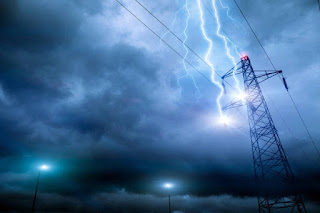
Direct lightning strikes to transmission lines or substations may damage the electrical equipment and threaten any nearby personnel.  More over a lightning strike on a transformer can cause a major explosion due to the amount of extra voltage injected into it. Lightning bolts can contain up to 120 million volts – depending on the length and size. When a transformer blows, it can knock out power for hundreds to thousands of people. In addition, collateral damages can occur because any line connected with the blown transformer, is now live and could be carrying thousands of volts. Blown transformers can also set its surroundings on fire, especially in dry environments. Because substations should operate reliably and because they are susceptible to lightning strikes, it is common practice to provide a Lightning Protection Design System for both outdoor and indoor substations. LEC lightning protection is based on some very basic principles: Don’t attract lightning, eliminate it If so...
LEC’s Comprehensive Lightning Protection Design System Process

Image
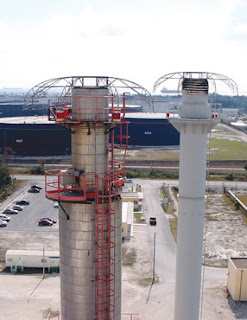
Science and experience show that LEC’s charge dissipation terminals, and the structures on which they are installed, are much less likely to sustain a direct lightning strike than unprotected structures or structures with traditional lightning protection design system. As a lightning downward leader is initiated in the cloud, an electromagnetic field builds up on ground based structures. A static charge accumulation is experienced on the facility and on the lightning terminals installed on the facility. The lightning terminals react by generating upward streamers having the capability to intercept the downward leaders.  These charge dissipation terminals or DAS are manufactured using stainless steel ionization brushes that neutralize build-up of static charges and thus mitigate streamer formation and lightning strikes . The lightning protection level of our systems consider both the lightning current parameters and the probability of not exceeding the maximum and minimum design va...

Lightning Rod Protection For Safe Lightning Dissipation

Image
A lightning rod is connected via a low-resistance wire or cable to the earth or water below, where the charge may be safely dissipated.  As a storm intensifies, it gets electrically charged; a lightning strike occurs when this cloud neutralizes itself with the ground. Any structure that sits between the cloud and ground gets charged and is damaged in the process. Thus a lightning rod protection is installed on the roof of buildings for protection. Lightning can " jump around " when it strikes. This "jumping" is associated with the electrical potential of the strike target with respect to the earth's potential. The lightning can strike and then "seek" a path of least resistance by jumping around to nearby objects that provide a better path to ground. If the strike occurs near the lightning rod protection system, the system will have a very low-resistance path and can then receive a "jump," diverting the strike current to ground before it ...

4 Essential Lightning Protection Products

Image
Franklin’s lightning rods have been used as a means of collecting and controlling the awesome and destructive power of lightning. But is it wise to allow thousands of amperes to flow near sensitive electronic equipment, especially when charge transfer systems (CTSs) are available and can prevent strikes in protected areas? With businesses around the world installing 500 such systems per year, it's a concept worth investigating. In 1971, Roy B. Carpenter Jr. came across the CTS technology while working for the United States Air Force. Carpenter was a chief engineer for the first space shuttle design team. After leaving the USAF, he expanded and patented CTS into the dissipation array system (DAS). It wasn't until the early 1990s that the theory behind DAS advanced and developed into the CTSs available today. Let us look at some of the lightning protection products available with CTS technology: The Dissipation Array System (DAS) is one of the most common configurations of a Cha...

Advanced Lightning Protection Systems Protect Manufacturing Plants to Farms

Image
Power generation transmission and distribution, fossil, solar, water treatment plants, substations and nuclear plants are typically constructed in large and unobstructed locations, making these systems susceptible to lightning strikes. Power Generation, Transmission And Distribution  Large power plants have been built to supply energy. Lightning events can damage facilities and equipment, disrupt work, and even cause injury or death to process-critical employees. A prolonged service outage from lightning strikes can negatively impact the community that a power generation facility is designed to serve. Fossil Fuel  Lightning strikes on fossil fuel facilities, refineries, tank farms and their upstream and downstream supply chains can be explosive and deadly.  Lightning protection for these facilities is mandatory.  Lightning strikes can be prevented around the most vulnerable areas and all areas can be protected with proper LP solutions. Solar  Solar farms are ju...

Lightning Protection Systems for Complete Industrial Property Security

Image
While lightning may seem rare, USA alone receives an average of over 2.2 million flashes to ground each year, and a single bolt of lightning has enough power to peak at 100 million volts of electricity. That much electricity surging through an office or industrial plant at once can be catastrophic for electrical systems and permanently destroy your most expensive electronics. Security for today’s commercial & industrial properties Schools, hospitals, airports, factories, chemical plants, power generating plants and office buildings are just some of the facilities choosing to play it safe against destructive forces of lightning by installing lightning protection systems. Like fire alarms, sprinklers and security systems, a lightning protection system provides the peace of mind that comes from knowing that a potentially catastrophic problem has been dealt with proactively. A properly installed lightning protection system safe-guards a business structurally and also protects property,...

Lightning Protection Design For Thermal Petrochemical Plants

Image
Lightning is a natural phenomenon that can have a significant impact on environment, production and people interacting with thermal petrochemical industries. Thermal petrochemical plants and their storage facilities are uniquely vulnerable to lightning due to the facility designs and the often explosive and caustic nature of the raw materials being processed, handled, and transported.  Lightning strikes at these sites can have catastrophic effects particularly fires and explosions that pose significant risks to personnel and may result in extended outages, loss of productivity, and equipment and infrastructure failures.  However, these consequences can be avoided with suitable lightning protection design and installation by certified companies. Modern Lightning protection design requirements are not adequately addressed by the national standards. A common example is explosive volumes that are created due to off-gassing from vent stacks, etc.  While a well-designed lightn...